 ## --------------------------------------------------------------------
 """
 Title: AC_RememberSelection.py
 Author: Andrew Kin Fun Chan
 Email: AndrewChan1985@gmail.com
 Date: Sept 2013
 Version: 1.0
 Compatibility: Maya 2011+ (It will probably work in older versions as well. Contact me if you have issues.)
 Function:        Commands:
 Load Selection:     reloadSel = AC_RememberSelection(1)
 Reload Selection:    AC_RememberSelection(0)
 """
 ## --------------------------------------------------------------------
 import maya.cmds as mc
 def AC_RememberSelection(x):
   if x == 1:
     print 'Storing Selection'
     loadSel = mc.ls(sl=True)
   else:
     print 'Reloading Selection.'
     mc.select (reloadSel)
   return (loadSel)
Sunday, September 29, 2013
Save and Reload Selection [Maya Python]
This is a Python script for Maya that can save your selection and reload it at a later point in your session.

Saturday, September 28, 2013
Zero Transforms with Groups. [Maya Python]
When it comes to rigging, it's important to keep controllers clean while keeping it's orientation. Since freeze transformations destroys the orientation data, this is a little script I wrote to zero out object transforms using groups.
Video Demo:
Source Code:
Video Demo:
Source Code:
 ## --------------------------------------------------------------------
 """
 Title: AC_ZeroTransformsWithGroup.py
 Author: Andrew Kin Fun Chan
 Email: AndrewChan1985@gmail.com
 Date: Sept 2013
 Version: 1.0
 Compatibility: Maya 2011+ (It will probably work in older versions as well. Contact me if you have issues.)
 Install Instructions:
      1. Copy the mel script (ZeroTransformsWithGroup.py) to your local user/scripts folder:
        Example path to icons folder:
        C:\Documents and Settings\*USERNAME*\My Documents\maya\#.#\scripts
      2. Copy the icon file (ZeroTransformsWithGroup.png) to your user/prefs/icons folder:
           Example path to icons folder:
           C:\Documents and Settings\*USERNAME*\My Documents\maya\#.#\prefs\icons
        3. Then type the below code into a Maya Python tab:
           import AC_ZeroTransformsWithGroup as zero
           zero.AC_ZeroTransformsWithGroup()
      4. Create the command on the shelf and so you have a button.
       You should now have a new shelf button.
       When you click the button it will create a group above
       your selection to zero out the transforms.
 Description:
     A script that will take your selection and zero out the
     transforms by putting an empty group above it with matching
     transforms. This script only works on single selection.
 """
 ## --------------------------------------------------------------------
 import maya.cmds as mc
 def AC_ZeroTransformsWithGroup():
   #Getting the Long and Short names of my selection.
   zeroSelection = mc.ls (sl = True, long = True)
   zeroSelectionShort = mc.ls (sl = True, shortNames = True)
   #Check if anything is referenced.
   if zeroSelection == None:
     print 'Please select something with transforms to zero out.'
   else:
   #Check if list is empty.
     if not zeroSelection:
       print 'Please select something with transforms to zero out.'
     else:
       print 'cool'
       for obj in enumerate(zeroSelection):
         i = obj[0]
         zeroParent = mc.listRelatives (obj[1], parent = True)
   #Create the empty group respecting the hierarchy. Checks to see if there is a parent or not.
         if zeroParent == None:
           mc.group ( obj[1], n = (zeroSelectionShort[i] + '_ZERO'), em = True, r = True, p = obj[1])
           mc.parent ((zeroSelectionShort[i] + '_ZERO'), w = True)
           mc.parent ( obj[1], (zeroSelectionShort[i] + '_ZERO'))
           print 'Created empty zero group in world space.'
         else:
           mc.group ( obj[1], n = (zeroSelectionShort[i] + '_ZERO'), em = True, r = True, p = obj[1])
           mc.parent ( (obj[1] + '|' + zeroSelectionShort[i] + '_ZERO'), zeroParent[i] )
           mc.parent ( obj[1], (zeroSelectionShort[i] + '_ZERO'))
           print 'Created empty zero group hierarchy.'
Monday, December 10, 2012
Geometry Paint Tool Maya 2011 and earlier.

Geometry Paint is a tool part of Maya 2012 as part of the bonus tools, but this has been in Maya for quite some time now. I will show how to use an artisian brush to paint geometry to another geometry's surface using Maya 2011. I haven't tried this on any version earlier than 2008 but I think it's been implemented as early as that.

Make sure the geometry you want to put on the surface has the pivot on the bottom with Y axis oriented up, and have the transforms frozen at 0,0,0 world space. For the geometry you wish to paint on. It must have UVs and must be at 1001 UV space. If you can't modify the UVs because of existing texture maps, than you could use UV sets to create a second set of UVs.

On the toolbar go to Modify>Paint Scripts Tool Option Box.

If this is your first time you'll need to navigate to the Setup tab.
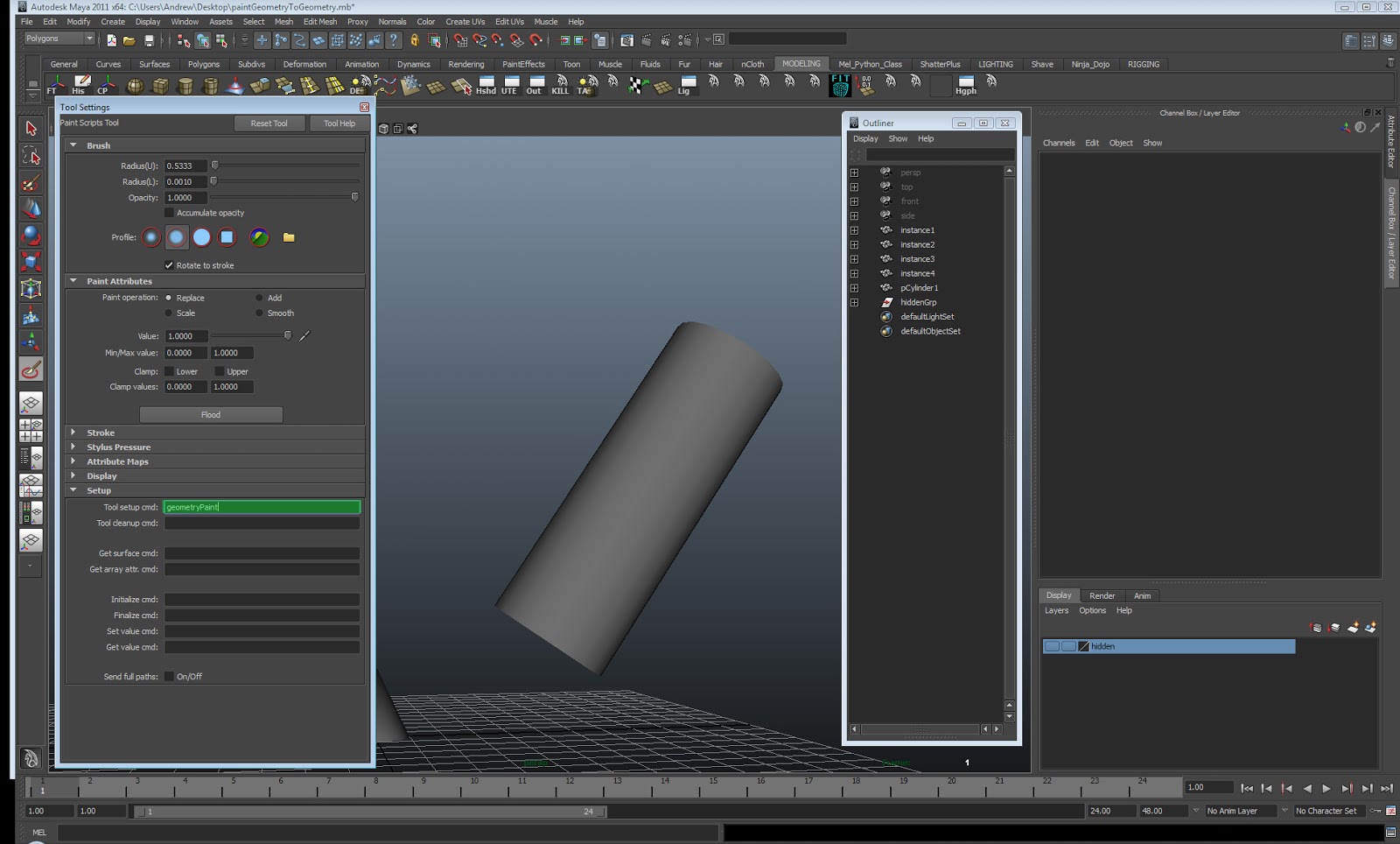
Type 'geometryPaint' into Tool setup cmd and hit enter.

After hitting enter, it will auto complete the rest and pop up another menu.

In Geometry fill in the name of the geometry you wish to paint. In my case, I've named it instance1, instance2, instance3, and instance4. These are the settings I chose to use in this example. I will go over some of the settings below. If you wish the geometry to be instanced have duplicate unchecked.

After you are happy with the placement of the geometries you are free to modify their translation, rotation, and scale. You'll need to set the brush to modify, and name the geometry according to modify the correct ones. For example if instance1 what I input, it will only modify those pieces. You'll need to use the brush settings by using replace/add, and using changing values. It may be easier to just manually rotate each piece after you have all the pieces oriented to get the desired rotation but I thought it would be good to cover the ability to modify through the brush.
Geometry Paint Settings:
One of the important things to take note is the U and V Grid size. In the example below I have it set to 5, and 8. In the below example the surface division level is 10, but the U and V grid size is set to 5. The brush will paint the attach the geometry to the grid point of the U and V grid you specify. In the two examples below I have Jitter Grid disabled so it is placing it uniformly.


With Jitter Grid turned on it will randomize the position of the painted objects. If you play around with Jitter Value it will also have different results.

Align option on and off. It seems to take positive Y as the vector it wants to orient to so make your your instance geometry is oriented correctly.


Below is a link to the documentation for each setting if you wish to learn more about it.
Maya Documentation on each setting
Tuesday, January 24, 2012
Joint Labeling Mel Script
This is outdated but I'll keep it here as mel reference..
Please refer to my Maya-Python function for Joint Labeling.
// This script joint labels your selected left joints. The script is very easy to modify to label the right and center joints as well.
Please refer to my Maya-Python function for Joint Labeling.
// This script joint labels your selected left joints. The script is very easy to modify to label the right and center joints as well.
// The script is name dependent. Currently my joints are named jntName_lf.
// It will strip out jnt and _lf from the name. If your joints are named differently feel free to modify it below in the Subsitute Command.
// If you have any questions feel free to email me at AndrewChan1985@gmail.com, or leave a comment below. Cheers!
string $mySelJnts[] = `ls -sl`;
for ($jnt in $mySelJnts)
{
// center jnts use 0.
// left jnts use 1.
// right jnts use 2.
setAttr ($jnt + ".side") 1;
// currently sets the type to other.
setAttr ($jnt + ".type") 18;
// strips out the name of the joint so have matching label names
string $jntNewName;
$jntNewName = `substitute "jnt" $jnt ""`;
$jntNewName = `substitute "_lf" $jntNewName ""`;
setAttr -type "string" ($jnt+".otherType") $jntNewName;
}

Tuesday, August 10, 2010
Interview With Emily Tse.
Andrew: Tell me a little bit about yourself, about your
life? What made you want to get into this industry and focus into lighting? I
understand you went to Ringling, but what classes did you study and challenges
did you face that helped prepare you to become the artist that you are today?
Was there any special training over at Ringling that produces such top quality
students? Roughly how many hours a week did you polishing your skills to reach
the level you are now, and maybe how many hours do you usually work now that
you're in the industry?
Emily: I started out as a very traditional artists.
Figure drawing and painting. I think traditional skills are what really helped
me get to where I am. At Ringling, they have a set of classes that everyone in
the major takes. You do traditional animation, CG animation, figure
drawing,concept art, and storyboarding. They basically train you to be a
generalist,but focus on animation. They're definitely an art school and not
very technical. At Ringling, you're basically working non-stop. In the industry,
at least I get to go home and rest...except during crunch. Which you still get
to rest, just not as much. Normally we just work around 45 hour weeks, but
crunch is definitely much more.
Andrew: Could you walk me through your hiring process for
the internship Pixar,and Disney which lead to scoring a Lighting position? Did
you just apply to Pixar or did the school provide connections to employees
currently there? How long did it take from the time you applied, to the
interview, and awarding the position? Did you do anything special with
presenting your portfolio, and were you nervous when they called you for an
interview?
Emily: For both Pixar and Disney I applied when they came to
our school. Ringling has a great career services program. With Pixar they were
fast. They came, gave interviews, left, gave phone interviews, then soon told us
the results. I don't think I did anything special really. And yes, I was
definitely nervous. When Disney called me, they didn't even know that I was at
Pixar until I told them. So It was all just really good timing.
Andrew: Was it challenging to keep up with the internship
program? After interning at both Pixar, and Disney, were you offered the
apprentice position or did you have to apply for it?
Emily: They were pretty different programs. Pixar was
just the internship, and was more of a classroom setup. Disney was more of
an apprenticeship, where we each had our own mentors. Pixar didn't have
any openings after the internship, but Disney was ramping up for Tangled, which
is what I'm working on now.
Andrew: How is the environment like over at Pixar and Disney
when you were there? What do you think other companies and schools can learn
from these two companies with the way they train their interns?
Emily: Both environments are pretty different, and
they're both great places to work at. It's interesting, cause you don't really
know what it means to work there as an intern. Nothing compares to what you
learn when you're actually in real production.
Andrew: Who are some of your favourite lighters? Do they
have any website or show reel online?
Emily: I'm not sure if I have favorite lighters. Since
I'm more of a painter, I have favorite artists. Lindsey Olivares, Sharon
Calahan(who is a DP at Pixar), Bill Cone, Paul Lasaine, Ben Plouffe, and
WassilyKandinsky, and Mark Rothko.
Andrew: Looking back, would there something you would change
with your demoreel to better meet their expectations? Do you have any tips for
students, and industry professionals who have their hopes to break into the
animation feature film business?
Emily: I don't think I would change anything. I think
most importantly, have passion for what you do. There's always going to be
tough times, and I've been pretty lucky, but love what you do, and always strive
to get better and learn more.
Andrew: I went to a school called Seneca where they offered
an 8 month 3d program. After failing to get into the Pixar, I was working at a
small company doing 3d work for documentaries which eventually lead to me
scoring a position to work on Tron. It's cool, but my passion is really
cartoons! If you can provide any feedback on my show reel and direct me as to
how I can improve on it that would be super!
Emily: Congrats on the job! That's great you're working on
Tron. So many people are excited about it. If you want to get more into cartoony
things, you should light cartoonier. In terms of colors, you could use more
variety. Not go crazy, but really look at your color contrasts. You have really
nice work, but instead of the darks going more grey, you could have it going to
a color. Also what's important, is lighting a scene with a character in it. And
try to make sure your lighting sets a mood and tells the story,making sure the
audience knows where to look.
I hope that was helpful!
I'm sure you've learned much working on Tron! Goodluck!
Wednesday, May 19, 2010
Interview With Kevin Edzenga.
Kevin was at Framestore since graduation and is now a cloth
simulation artist over at Bluesky. We both graduated the same year but he's
been able to climb the ladder much faster. Here's an interview I had with him.
Andrew: Could you walk me through your hiring process at
Bluesky? How long did it
take from the time you applied, to the interview, and
awarding of a
position? Did you do anything special with presenting your
portfolio? Were
you nervous when they called you for an interview? What was
your initial
reaction when Bluesky awarded you a position? Did you apply
specifically for
cloth simulation artist or were you going for another
position originally? I
noticed on your Youtube channel, it's mostly crowd
simulation, particle, and
mel scripting reels! Do you also have a cloth simulation
reel hidden away?
Kevin: The hiring process with Blue Sky was rather out of
the blue. A recruiter found my reel and resume link online. He was acting like
he wasn't sure where but out of all the places I put up links and my reel it
had to have been found at youtube/vimeo.
But after submitting my resume and ncloth / nucleus related
work to Blue Sky, through that recruiter, it took maybe a week or so before
they set up an interview and got me in there the week after that. (figure about
2 weeks to get my work in to the date of my interview. Mainly because there was
a nasty snow storm and kinda destroyed wed-friday of the first week.)
I was asked by the recruiter to put up a single page related
to the job I was going for. The page had some stills from a few vids including
ncloth and a few youtube vids that I would be able to show real easily.
Definitely a good idea to make things streamline and sleek for people to view.
As for being nervous, I've had such good luck with getting
contacts and getting call backs that I don't know that I've ever been really
nervous. Even when I meet "famous people" has happened only a few
times. I don't really care, they are people like any of us, and the last thing
they need are more people falling head over heals at the sight of the
person.... not like I'd do that anyway. Can't think of anyone I might do that
to, maybe les claypool, stephen hawkings, and Michio Kaku(a great physicist
teaching at NYU right now.)
I got in and showed my other reels to Stich (Keith
Stichweh), my lead, and he watched it all, told me to say some stuff about my
work as it showed (too much to say in only 2 minutes hah). He got a few of the
guys in to ask me questions about my work, then put me on the spot and showed
everyone in my dept. That was pretty cool, but was afraid of what after math
might occur from all my stuff just being put out there in the open. Had a little
bit of a waverly voice, but not really that nervous, kinda more like all these
great 3d guys and I didn't know where I stood compared to them, thinking, hey,
this is Blue Sky after all. Turned out I had something I could add to their
dept.
As for hidden nclothness, my newest reel has one bit of
ncloth but nothin crazy. I had shown a few screen shots from my friends thesis
that I set up snow on the ground so as the characters would walk they would
press in the snow and that was all ncloth. I also told them about some RND
stuff I couldn't show because it was locked down at Framestore because the
movie Salt is yet to come out.
Andrew: How is it like working at Bluesky? Did you have to
do any training or
test when you started, or were you thrown right into fire?
Was the learning
curve a difficult hurdle to overcome coming straight from
school or was it a
smooth transition? What are the work hours like, and how is
the work
atmosphere? What are some of the neat things you have learnt
from other
artists that you have worked with or seen?
Kevin: Blue Sky is a blast, although the major crunch work
has yet to really hit, the work I have is setting up sims and then having like
30min-an hour to play ping pong or pool. It gets really tiring, I must tell ya.
Ha.
Well, the first week there was getting used to the pipeline
and an hour training once a day till I got used to all the tools. Everyone here
is so knowledgeable it was well worth it to expand my knowledge base.
The training was a definite help to a smooth transition into
the burning hot kitchen at the time, that since has cooled to luke warm.
But I can't really mention what neatness I learned. But I
can say everyone has a diverse knowledge base and can contribute a lot in their
own areas, and have in situations.
Andrew: Are there any learning resources or tips you can
give to students who
want to become a cloth simulation artists when the school
only offer 3d
training in all the fields except dynamics?
Kevin: Uhhhhhhhh, hmmmmmm, cloth sim takes a lot of time to
get processed, soooo ... learn to have patience with the definite need to rerun
sims of the same thing multiple times, hah. Frankly, just try to jump into
messing with settings on the ncloth shape and you can begin to see what the
different settings do.
But that is what my school was like, character / animation
driven. That they'd rather a nice story rather than a cool looking design and
feel. There were some specialty classes, but when you go up to a teacher and
ask "Should I take your class?" for them to tell you "You know,
if you took my class, it might just be a waste of your time, you already know
more than what I go over in the class." That was from a teacher by the
name of Vic Fina II, a true generalist, modeling, animation, FX, dynamics
My teacher, Vic, who I wanted to take that class with was a
great resource, having worked at CBS, NBC, CNN, and now hes at the John Stuart
show now as the resident lower third, any graphics really at all guy. I would
go to him to ask about dynamics and we would go into a lot of ideas, both of us
learning off each other and the other like ... two students that were willing
to learn things outside of the curriculum. (Both of which are now staff at
Psyop and Rhino FX in NYC, great commercial companies)
Andrew: Tell me a little bit about yourself, about your
life? Where did you go
to school, and what classes did you study? What challenges
did you face, and
what helped prepare you to become the artist that you are
today? Roughly,
how many hours a week did you spend polishing your skills to
reach the level
you are at now?
Kevin: This question is a book in and of itself. I'm not an
average learner. I didn't meet the standards of my public school system for
reading(since I would rather be on the computer playing games or writing
stories and what I called poetry) and was forced into these classes to wax me
into reading more but it just pushed me more and more into my computer work at
home. Starting web design when I was about 6 and level design for games like
Doom and Duke Nukem 3d when I was 4-5. Which from that point turned into Bryce
around age 8 or 9 before my parents bought me Ray Dream Studio 5 when I was
about 10-11. That is when my crazy creations started turning into virtual life,
filming things and trying to overlay 3d with video (pretty poorly I might add,
having no patience for what I later found out was rotoscoping, but what do you
expect I was a middle schooler). Then into highschool I took a set of classes
in a Communications University Program, getting to use Final Cut Pro, Pro
Tools, and everything broadcast and non. This was a great help to me, cause
there was a film appreciation class, a public speaking class, philosophy class,
and a few others that made it worth wild outside of just film and sound.
It was early elementary school that I started to begin to
love math, to indulge myself in web scripting like html and java script.
Anything logic based filled me with joy. I would play Myst for hours upon days,
then got sick of it, moved to riven, got sick of that, moved to other MUDs and
MOOs (respectively, Text based RPGs, text with images based RPGs) and odd other
RPG / RTS(mainly starcraft, WOO! Starcraft!! hah) / Adventure games (Exile,
Uru, D'ni). Then starting flash and actionscripting around age 11. Php and
mySQL databases around 16-17. Doing freelance work since I was 13 for websites.
A multitude of games and movie stories that have yet to come to fruition but I
still strive to complete.
But even with the ill will toward reading, after going
through my public school system I had found out once hitting college that my
school system went over FAR more things than many many other school systems in
america (from the people I've talked to). Needing to reread books in college
that I read like junior year in highschool. It was as tho most of america stops
where I was in sophmore year of highschool but as seniors.... it's kind of sad
and made me understand why people from other countries think that americans are
dimwits with no sense to even give respect to fellow men and women of the
world. Many of my friends made similar assessments of their peers in college as
well. I guess that is a reason they say there are good public school systems in
New Jersey. Anyway, I digress to the point of your question.
I went into the School of Visual Arts in Manhattan NYC from
2005-2009 for a BFA in Computer Art; initially interested in modeling and
perhaps animation having no real cocept of what was out there in this computer
art field.
I was pretty much the only one doing 3d graphics in
highschool and was far more interested in physics than art. But I was
enlightened by the problems faced by riggers and FX artists from homework and
classes in SVA; I also had no clue there was scripting in 3d, so I took to that
like knats to someone standing in a field on a summer evening.
Why I chose art over physics alludes me now more than ever,
welllll sorta. Initially I thought it would be more money quicker, but there
are so many jobs that pay so well for physicists. Bahh, the thrill of logic
problems, scripting workflows, particles / dynamics(the two closest things to
real physics, yes, ncloth is just settings, no real physics work there) and
coming up with awesome rigs I guess is the only things I can say now as a valid
reason for being in 3d. This answer has pissed people off before, who's hearts are
filled with everything 3d, sorry if you feel this way as well.
As preparation for my career choice, I used to overstep my
bounds in classes. To a point where teachers almost and straight didn't like
me. I'd do my own thing to mix it into homework. I thought it was pretty sweet,
and only two teachers really thought it was cool what I was doing(Vic didn't
like it, but took my insanity to heart and graded my work as it was rather than
based around the assignment it was, Vic is soo cool). My thesis teacher liked
my story ideas the first year but the second year began to dislike my work
quite a bit, that I wanted my thesis to be entirely scripted, a particle and
dynamic driven thesis. But he wanted a story. But I stuck to my guns and it got
me an internship with Framestore 2 days after graduation (with the help of one
teacher that I'll get into later in this email); then from there, even more
work with them and many other companies now.
I would be working every day on new ideas. Try to come up
with new things that look cool, that act with a life of their own, or tools to
speed up workflow no one else has made before. I tried my best with what I knew
to make the neatest stuff I could. Every day you learn something new, and I
would make a point off learning something even if I slept from 9 am to 6 pm
because I didn't sleep 3 days prior. For an hour span, boy, sophmore and junior
year I'd catch myself doing my own work rather than school nearly 4-6 hours a
day minimum. In a week I'd spend 70-80 sometimes maybe 100+ hours some weeks
pure work. Literally not sleeping 3 days straight a multitude of times
throughout school; living off of Chapotle burritos and energy drinks. Among
some stuff I shouldn't mention, heheh.
Andrew: What inspired you to specialize in rigging,
scripting, and fx? Do you
have any other ambitions or did you always know that you
wanted to do that
when you were in school? Were the professors able to teach
you what you
needed, or was it mostly self taught?
Kevin: Ya know, they taught us young to read all the
questions before answering the first one ha, I'm sure some of this was answered
above.
It was the logic problems. Figure out how to make this that
or the other thing because an animator is going to need it to do this in this
situation or that in the other situation. But that love of math was a good base
for physics. But that is a story alone. My phyics teacher in highschool didn't
like me much (also my math teacher, but again, another story) but he would
teach us like we were morons because it wasn't the AP (advanced placement
class) that I was forced to take because of class conflictions with that
communications film/audio program in highschool. He would teach us an algorithm
to do one thing and I would realize there was a far simpler algorithm to find
the same answer in half the steps. He wouldn't mark me down but I can't tell
you how many times I saw "Please use the math we learned in class to solve
for variables in the problem."
But in college, I got a great base from every teacher in each
field. Making sure to take teachers of every kind in the industry to widen my
knowledge base as much as I could. I wanted to know everything to be the best
TD I could and will be. Oddly enough not taking a single rigging class beyond
basic IK/FK switches from Vic, which I later figured out better switches on my
own. I was going to take a rigging teacher, but some reason I dropped out of
that class, something about getting given answers to a problem just doesn't
bode well with me.... yeah I know, stupid, but was talkin with my friend in the
class, realizing I covered most of what he was doin on my own anyhow. Latices
to make squash and stretchable eyes, expressions to run math, nodes to process
as equations. Stuff that is basic in math, but not for artists I guess (not
all, but some artists obviously)
Andrew: Aside from portfolio pieces, is there a reason that
you enjoy helping out
others with their short films? I really appreciate that your
helping me out
on my short film!
Kevin: Haha, no prob man. Well, I've always enjoyed helping
people. I'd help many people in my classes in college just because if it was
something I didn't know already, we'd work it out and find a solution.
So if by helping you I may be able to show you something you
didn't know about rigging, it makes me feel good that I'm helping you expand
your knowledge base.
The way I see it, people that don't help those who need
help, don't help because the tricks they hold are all the tricks they know. But
if you can take tricks you have and turn them into something new and unique for
more than one situation, then to show something a technique is simply a small
part of a huge picture.
Andrew: Is there a project, company, or director that you'll
want to work with in
the future?
Kevin: I know nothing about movies, tv, radio, commercials,
broadcast, what ever. Should I even be in this industry? Probably not. Everyone
in my dept talk about movies and tv shows and I'm sitting here reading this
awsome book on Superstrings, Super Gravity and The Theory of Everything, a
really cool book on sub atomic particles and it goes into the history behind
theories along with the mathematics that I've been trying to find in these
commoner books for a while. I may not be in physics, but I will keep my hobbies
as they always were. (These books are one reason my physics and math teachers
didn't like me in highschool.)
I guess what I'm trying to say is probably ILM because they
have one kick ass RND dept there, that and imageworks has a pretty sick RND/FX
dept. Although my dream may be comin true at Blue Sky, they might be moving
more RND/FX stuff to the cloth dept because each dept here wants to do what
they specialize in and cloth is a bunch of TDs from riggers to dynamics to fx
to modelers/animators. Not to mention all of us program/script in this dept.
Andrew: Who are some of your favourite FX artist, and
riggers? Do they have any
website or showreel online?
Kevin: I dunno, Miguel Salek from Psyop is pretty sweet at
his houdini work.
But really, his work is simple but many layers of simplicity
makes something beautiful, amazingly beautiful. The reason I say its simple is
that Spencer Lueders from Framestore NYC taught me sooo much about Houdini. He
taught me for a semester in SVA and got me a job with Framestore working along
side him doing Houdini for a Tylenol commercial and for the movie Salt doing
smoke, particles, dynamics, and more Houdini stuff. He knows his stuff, not to
mention he was the guy testing out Houdini while he worked at Side Effects, so
he knows that program pretty much inside and out. Which is now allowing me to
possibly move to a crowd simulator spot in Blue Sky using Houdini to simulate
the crowds, which isn't too hard remembering what Spencer taught me. (He
doesn't have a reel yet, and he even mentioned while I was at Framestore that
he needed to make one, that it had been yearsssss and he still didn't have one.
But you have definitely seen his work around.)
I haven't seen to many riggers that have done work that I
couldn't figure out some way of doing what they did (besides a few things that
required the API to write a plug in for, which I'm yet to get into, but will be
soon). I hope that doesn't sound like boasting; but I've tried long and hard to
get my rigging skills up to industry standards and beyond.
But this doesn't mean people like James Dick, Andy Walker,
and Theo Jones aren't great, Rigger, TD, TD respectively, at Framestore NYC. I
learned a bit from them, but they were also cool enough to let me do my own
methods to get jobs done, as long as the project met its deadline, everything
was golden.
But like I said, I don't know this industry, there are
people out there that are great riggers, but the names escape me.
Andrew: Looking back, would there something you would change
with your demo reel
to better meet their expectations? Do you have any tips for
students, and
industry professionals who have their hopes to break into
the animation
feature film business?
Kevin: Well, if you see my fall 2009 reel and my spring 2010
reel, those were the changes I wanted to make. I guess looking at the 2010
reel, I want more transitional videos taking you from piece to piece. Or maybe
some sort of particle based environment that builds up into each peace in a
hologram style effect of some sort. But for me to say "I wanted to adds
betterz workz!@!$%!" would be futile in that I will always be adding newer
and I would hope ultimately better work.
Don't get down if someone says they don't like your work,
because there will always be people who say that. One, because maybe they are
simply better than you; two, you could still be progressing in the field and
don't have the experience yet that they would want to see; three, that you are
better than they are and they feel threatened by this and make themselves feel
better by putting you down.
My friend does the latter of the three often. Man he was
making fun of Avatar as much as he could, I simply responded, your skills can't
hold a flames to the people at weta. Man that pissed him off, and retaliated
with "and you think you could have made any of those rigs or
effects?" I said "yes, most of them", knowing full well there
are quite a few intense rigs in Avatar, but he did the classic "yeah
whatever" and shut up.
Saturday, March 6, 2010
Interview With Lindsey Olivares.
Lindsey graduated from Ringling College of Art and Design in
2009. She's been at Dreamworks PDI working as a Visual Development artist ever
since.
Short Film: http://www.youtube.com/watch?v=WuZRcE9J3Gc
1) Could you walk me through your hiring process at
Dreamworks? How long did it take from the time you applied, to the interview,
and awarding of a position? Did you do anything special with presenting your
portfolio? Were you nervous when they called you for an interview? What was
your initial reaction when Dreamworks awarded you a position?
I had been in contact with some people from Dreamworks
throughout my senior year. I was featured on the character design blog and a
Dreamworks artist saw my interview and artwork and showed it to his production
designer. This really got the ball rolling and when Dreamworks came to my
school (Ringling College) for their recruiting visit they told me I had a job
offer during that interview. I found out the details of that offer in the week
after and accepted the position officially a few days after. I was incredibly
excited and called up family and close friends to let them know the good news.
2) How is it like working at Dreamworks? Did you start off
as an intern, or were you hired fulltime? Did you have to do training or
drawing test when you started, or were you given work to do on Madagascar 3
immediately? Was the learning curve a difficult hurdle to overcome coming
straight from school or was it a smooth transition? What are the work hours
like, and how is the work atmosphere? What are some of the neat things you have
learnt from other artists that you have worked with or seen?
I started off hired full time. I had a day of basic
orientation training, but I pretty much started work on the film immediately.
Since at school I mostly worked in 3d and animating I haven't actually
digitally painted a ton. So I'm still learning a lot and trying to improve
constantly. Work hours are 9-6. I don't really put in overtime. Its relaxed and
not a stressful work environment.
3) Tell me a little bit about yourself, about your life?
Where did you go to school, and what classes did you study? What challenges did
you face, and what helped prepare you to become the artist that you are today?
Roughly, how many hours a week did you spend polishing your skills to reach the
level you are at now?
I grew up in San Diego California. I knew I loved to draw at
a young age. I came from a very creative and supportive family. My father is a
professional guitarist/musician, my older sister Brooke is a very talented
painter, and my mom is the type of mother who'd let her kids paint murals all
over the walls in the house. Growing up I was surrounded by people who
encouraged my passion for creativity. Like most little kids I loved animated
Disney movies; these movies made me want to be an animator. I didn't really
know what that meant, but I knew those movies were all moving drawings…and that
was too cool. I had my first real taste of animation at Cal Arts' summer
program for high school kids called CSSSA. That sealed the deal for me as far
as my decision to go into the animation world. Then I decided to take the 3D route.
I ended up moving out to Sarasota Florida to study computer animation at
Ringling College of Art and Design. At Ringling I took classes in concept,
drawing for animations, 3d character animation, figure painting, landscape
painting, graphic novel illustration, children's book illustration etc. I felt
challenged in balancing my time. I spent most my time animating but wishing I
was drawing. That was a big challenge for me and trying to find time to draw,
paint, and create the type of work I wanted to be making. I worked nonstop,
it's hard to say. At school It seemed like I was always working, unless I was
eating or sleeping. But sometimes those overlap too :)
4) What inspired you to become a Visual Development Artist?
Did you always know that you wanted to do that, or do you have ambitions to do
other specialties like animating, modeling, texturing, etc? What are some of
the things that you do to keep yourself creative?
Originally I wanted to be an animator. I wanted to be a
traditional animator since I was a kid. When the industry went 3d I decided to
go to Ringling College to study computer animation. I still thought I wanted to
be an animator but didn't really understand the pipeline. In our first year we
take two semesters of 2d animation. I really enjoyed those. But when we got
into 3d I just couldn't find myself enjoying animation. I just craved to draw
more. Drawing is really where my heart is. We had a concept class where we
focused on story, character/environment design. I loved this class and started
to learn of what visual development was. I realized this is what I wanted to
do.
To stay creative I try to go out drawing. I like to go to
malls, food courts, and cafes to people watch. Aside from drawing, I don't do a
ton to go out of my way to be creative and get inspired. Inspiration seems to
happen on accident when you're living life. It's hard to plan. I guess for me
it's more about trying to see the artistic charm in our daily life experiences.
My favorite ideas have come from personal experience, sometimes it's a
character, memory, or story message that rings true to me. I love thinking in
cars...driving around late at night, or as a passenger staring out the window.
5) What inspired you with the idea for your short film,
Anchored? Were there any challenges you faced when doing the film, and how did
you overcome them? I was wondering if you could talk about the shading style
for your shorts; is this a diffuse map connected into a toon shader?
The inspiration came from my personal life experiences and
what I believe. When thinking of an idea I was reading the Bible and looking
for inspiring verses. I read, "But let him ask in faith, with no doubting,
for he who doubts is like a wave of the sea driven and tossed by the wind"
James 1:6 and "May the God of hope fill you with all joy and peace as you
trust in him, so that you may overflow with hope by the power of the Holy
Spirit" from Romans 15:13. I also wrote down notes from the parable of the
lost sheep..."What do you think? If a man owns a hundred sheep, and one of
them wanders away, will he not leave the ninety-nine on the hills and go to
look for the one that wandered off? And if he finds it, I tell you the truth,
he is happier about that one sheep than about the ninety-nine that did not wander
off. In the same way your Father in heaven is not willing that any of these
little ones should be lost." Before I figured out my story I had written
out verses like these. My sketchbook was full of verses, quotes, parables, song
lyrics, and many loose pieces that I tried to sort together to find an idea. I
wanted to make a film with a strong message, and I wanted to create a feel-good
piece. I wasn't sure what message I wanted to share and felt stressed over
trying to find something meaningful. When I put aside all the pressure of what
I wanted my film to be and started naturally working out the story, the
original meaning of the verses and metaphors were clearly revealed in my story.
It worked out so smoothly that I really felt like it was a story from God, and
I was able to use my art as a messenger.
A lot of the details are influenced by my life. While I was
thinking of a story I was at a low point, feeling discouraged and doubting
things I knew. I had some moments feeling adrift at sea. Also during this time,
two of my really close friends were away for a couple years and the only form
of communication we had was through handwritten letters in the mail. Sending
letters was such a change from the instantaneous communication we have these
days. I was interested in that type of conversation and really appreciated the
meaning of receiving a letter from someone you don't see anymore. Some of the
letters I received were so encouraging and hopeful. They really helped me gain
perspective. I think that feeling shows through in my piece when the man adrift
at sea is surrounded by all the origami crane letters. When I was working out
the story, I didn't plan to put specific details from my life in the film. It's
subconscious and natural. We do what we know, it makes our work honest and
truthful. You need to share a part of yourself to really give a story that
heart and emotion. I really don't feel like the message came from me. I think
it was something that worked itself into my film, and something that I learned
from while working on this project. I learned from the message in my film, it
really spoke to me. I truly have felt like both my characters and have learned
from the message in my film. The inspiration comes from God and how I've
interpreted my life into story.
Just finishing the film was a challenge. When I think of a
concept, I try to be practical about how much work I can take on, but at the
same time I don't like to limit myself with worries about the things I don't
know how to do. Taking on challenges is a great way to learn. This was my
thesis film at Ringling College of Art and Design, so the curriculum was set up
that we'd spend a semester in our 3rd year planning the film with story and
art, and most of our senior year executing the film in 3d. There were so many
parts of the film that I assumed I'd just figure out later..during the second
semester of senior year "later" was approaching fast. I didn't know
how I'd make the water, how I'd rig a rope of words that the characters
interacted with, and how to transition between 3d and After Effects. Some
things didn't seem like too big of a deal, but when it came to actually
executing it, they were much more challenging that I had assumed. My film was
experimental in style and combined several elements so executing the look of
the film was a challenge. I had a lot of manual tracking in After Effects that
was very tedious. I was working in full HD scale so it was slow and challenging
to maneuver in After Effects at times. The shot with the cranes flying from the
man in the boat across the sea to the woman was tricky. It's a mix of After
Effects and Maya and was difficult to blend the two. In 3d it was too difficult
to animate the words moving over such a large distance and have the camera
tracking the words over such a distance while attempting to have words move by
smoothly as if your reading them.
Smoothing up all the loose ends and tightening up the piece
took a long time. There were a lot of pops in the animation's motion, pops when
a 3d model of a crane switches to a stop motion After Effects crane, pops with
the transitions come in too suddenly and etc. There were a lot of jarring
sloppy pieces that interrupted the flow of the piece. Just cleaning up was hard
for me, catching glitches, intersecting geometry etc and getting everything
fixed in time. As a one man team making a 3 minute short in a school year, my
time was so limited. There's still so many things I would've liked to do with
the piece that I didn't get around to. I had to learn how to prioritize and
keep everything in perspective. It was hard finding a balance in my priorities,
working the piece closer to a finish as a whole and sacrificing certain aspects
that remain very unfinished in my eyes. I overcame this challenge by keeping in
mind that I was making this film to motivate and uplift people, The story was
already working so I held on to the hope that my film would have that effect
regardless of the unfinished cloth, various rough parts in the animation, or
all refinement in the water, transitions, and effects that I never got around
to.
The characters have exaggerated color maps for their
textures. I exaggerated the colors in their faces and clothes, including
variations in values. I wasn't relying completely on the lighting to show the
form. A lot of the value and hue shifts are built in to the textures and
shaders. The look was achieved in compositing my render passes in After
Effects. I used a diffuse color pass which is the raw color without being
affected by lights. From there, I manipulated a series of other passes in After
Effects and composited them together to create a look with a watercolor/ hand
painted sensibility.
6) Do you have any plans to produce more short films on the
side?
Currently my greatest ambition is to make short films. I
recently finished my thesis film "Anchored" It was the greatest
project I ever worked on. Working on it was so stressful, exciting, and
addicting. I loved making my own film. After completion, being able to share it
with an audience was such a blessing. I received so much wonderful feedback and
a lot of emotional response. It means the world to me to hear that someone can
feel uplifted and happy from watching my film. I'm craving to do more work like
that in the future.
7) What is your most favorite subject to draw? And why?
I like drawing animals or funny looking people. Generally I
don't like drawing kids and pretty people…I have more fun when things are
chunky, droopy, wrinkly, aged, awkward, etc. It seems more real to me to draw
unappealing things and try to give them appeal. Animals are fun because there's
already a lot to work with when designing them. I think of God as the ultimate
designer… he must have had a blast with the animal world creating so many
interesting shapes, sizes, patterns and textures. Human shapes are more
familiar but the animal world seems to have more unique elements to work with.
8) Who are some of your favorite artists?
When I was interning at Disney I gained such an appreciation
for raw beautiful drawings. I was able to see collections of original animation
drawings…they were incredible, I think some of the most amazing artists and
draftsmen are the 9 old men and other Disney artists ranging from Mary Blair to
Glen Keane. Some other designers and illustrators I enjoy are Charles Harper,
Ronald Searle, Alice and Martin Provensen, Erich Sokol, Nico Marlet, Joe
Moshier, Paul Felix, Tadahiro Uesugi, Egon Schiele, Gustav Klimt, Sterling
Hundley, Norman Rockwell, Dean Cornwell, Chris Ware, and so many more than I'm
leaving out.
9) Looking back, would there something you would change with
your demo reel to better meet their expectations? Do you have any tips for
students, and industry professionals who have their hopes to break into feature
film business?
My advice is to show your best work and show a diverse body
of work that will show the company that you can fit in there. That you have a
diverse range so they trust you can take on the style of their film. And to
show the type of work that you'd be doing there, so they can see if you'd be
ready for production. For a visual development job that's usually a lot of prop
design, and lighting/mood paintings.
Subscribe to:
Posts (Atom)